
The homeowners policy detail that quietly decides whether your roof gets replaced after the next storm
Most homeowners in Southern Indiana think of their homeowners policy as one thing: coverage on the house. They renew every year. The declarations page shows a dwelling limit. They assume that if a storm takes the roof off, the check comes to replace the roof.
For a lot of families, that is still true.
For a growing number, quietly, it is not. And the detail that decides which group a household lands in is buried on the declarations page under a phrase most people never read: how the roof is being settled at the time of a loss. Replacement cost. Or actual cash value.
One of those pays for a new roof. The other pays for a used roof.
This post walks through the difference, why more Indiana carriers are moving aging roofs onto actual cash value settlement, and what a homeowner should actually do about it before the next storm.
The two ways a roof gets settled
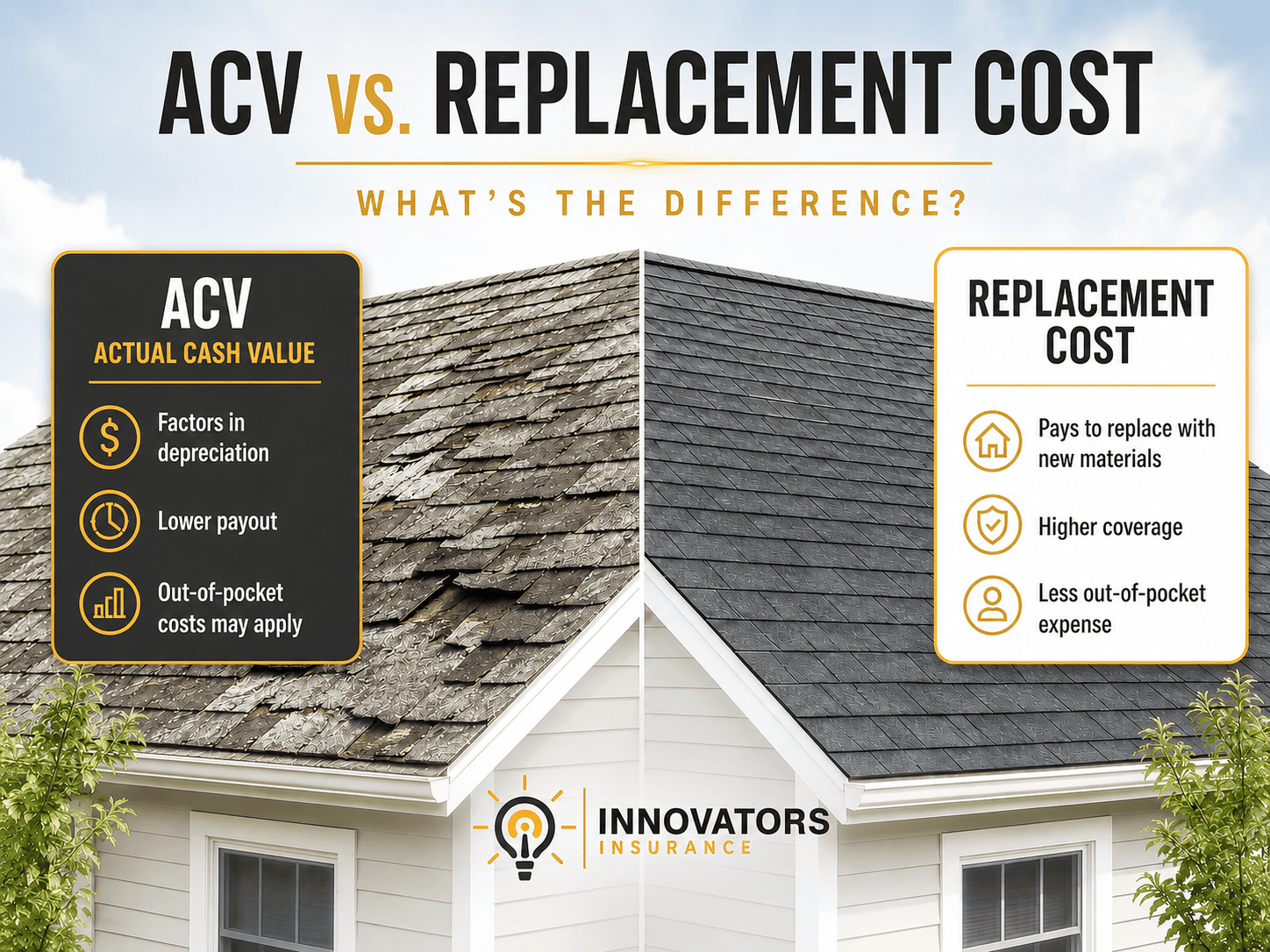
Replacement cost value (RCV). The carrier pays what it costs to replace the roof today, with materials of like kind and quality, minus your deductible. If your fifteen-year-old asphalt shingle roof comes off in a hail storm and the total replacement cost is $20,000 with a $2,500 deductible, the carrier’s number is $17,500. You are writing a check for the deductible. Not the depreciation.
Actual cash value (ACV). The carrier pays what the roof is worth today, which is the cost to replace it minus depreciation for how much of its useful life is already gone. On that same fifteen-year-old roof, with a twenty-five-year expected life, the carrier’s depreciation number could be sixty percent or more. On an $20,000 replacement cost, sixty percent depreciation is $8,000. After a $2,500 deductible, the settlement is around $5,500. The roofer still charges $20,000. You are writing a check for the difference.
That is the exact scenario that ends up as the phone call nobody wants to make.
Why more Indiana carriers are moving to ACV on aging roofs
A decade ago, most homeowners policies in Indiana settled roofs at replacement cost regardless of age. Carriers took the depreciation hit as part of doing business. Weather patterns, roof material costs, and litigation trends have changed that math.
Over the past several years, carriers across Indiana and the Ohio Valley have introduced roof settlement schedules that shift older roofs onto ACV automatically. The specific triggers vary by carrier. Common thresholds we see:
-
Roofs over ten to fifteen years old moved to ACV at renewal.
-
ACV applied specifically to hail and wind losses, while other perils still settle at RCV.
-
Depreciation schedules tied to material (asphalt shingle depreciates faster than metal or tile).
-
Some carriers now require a roof inspection before renewing an aging roof at RCV at all.
Here is the part that catches homeowners: the change often happens quietly at renewal. The declarations page changes. The premium may not. Unless someone is looking at that specific endorsement each year, the policy can drift from RCV to ACV and the homeowner has no idea until the claim.
The three questions to ask before your next renewal
If you are a homeowner in Charlestown, Jeffersonville, New Albany, Clarksville, or anywhere else in Clark or Floyd County, these are the questions to ask your agent this year.
One. How is my roof being settled at time of loss? Replacement cost or actual cash value? If ACV, is it applied to all perils or only to wind and hail? Get the answer in writing, ideally from the current declarations page or an endorsement.
Two. If my roof is currently on RCV, what is the age or condition that would move it to ACV? Every carrier has a threshold. Knowing the threshold tells you when to expect the settlement basis to change and whether it makes sense to plan a roof replacement before you land on the wrong side of that line.
Three. Are there markets where my roof would still settle at RCV, and what would that cost look like? This is where an independent agency matters. If the current carrier has quietly moved your roof onto ACV, another carrier may still write it at RCV. Sometimes the premium is higher. Sometimes it is not. But you cannot know unless someone looks.
What we do at renewal for our homeowner clients
Every year at renewal, we look at three things on the home policy specifically related to the roof:
How the roof is being settled today. RCV or ACV. All perils or just wind/hail.
What happens at the next renewal based on the roof’s age and the carrier’s schedule. Some clients have a roof that will roll to ACV at the next birthday of the policy, and they should know that now, not next August.
Whether other carriers in our appointment list would settle the roof more favorably. If yes, we walk through what a switch would look like. If no, we make sure the homeowner understands the exposure and can plan around it.
This is one of the reasons we invite our clients in for renewal reviews, and one of the reasons we do not treat renewal as an automatic.
What to do this week
Pull out your homeowners declarations page. Look for the words “actual cash value,” “ACV,” “roof settlement schedule,” “windstorm and hail,” or a roof age endorsement. If you find any of those, your roof is being settled at less than replacement cost, and you should know exactly how much less before the next hail storm.
If you cannot find the answer, or the declarations page is not clear, our personal lines team walks through this with homeowners every week. Bring the declarations page. We will read it with you and tell you honestly what it means.
Innovators Insurance Group works with homeowners across Charlestown, Jeffersonville, New Albany, Clarksville, and Sellersburg to make sure the renewal doesn’t drift and the pieces that decide the claim check are looked at every year. If you would like our personal lines team to walk through your homeowners policy with you, we would be glad to.
Not just insured. Truly protected.